 If Thanksgiving perplexed me, then this Holiday season overwhelms me more. Frosty the Snowman, Santa Claus, reindeer, and a host of 5-foot-tall Christmas Nutcrackers appear to be visiting Baby Jesus in a lit-up manger right up my block. The owner of the home, Tom, was so happy putting it all together that it’s hard for me to even be mad at him. I must admit that I like watching people like Tom find such immense joy at what appear, to me at least, to be some of the tackiest, most contradictory aesthetic displays imaginable.
I have fond, childhood memories of this time: the kitchen of the aunt who helped raise me and the joy and laughter everywhere when we were stuck inside in the Ohio, winter months. I have memories of my cousins, the single mothers, who always talked to me like an adult even when I was really young, explaining how they planned and saved money for their children’s gifts beginning in July and August. They were all struggling in all kinds of ways but always saw to it that their children would smile every Christmas morning (it was only as an adult that I figured out that my mother was doing the same.) It wasn’t about the gifts ever, just surrounding their children with the kind of wonder and awe that poor people are not supposed to experience. The financial planning that working class/working poor single mothers did back then during the holidays (no one I knew had credit cards) represents a financial genius that could re-organize our collapsing economic system, if that was what we really wanted! A working class, single mother who is doing it all on her own, without the social imprint of needing male (sexual) attention or patriarchal protection, has a formidable skills-set, at this time of the year and every other time. So every year around now, I especially remember these women. I certainly see and appreciate all of the listings of suggested eco/cultural/conscious gifts to buy during the holidays, but I also remember an anti-capitalist analysis of the greatest ploy in the Western world to keep today’s working class in debt. It was young, working class black single mothers— my very own cousins who made me into the little sister who would carry their heart’s torch— who gave me this political lens.
At this time of year, I also turn my gaze to the Winter Solstice, thanks to the help of a college friend a few years back who has shared some of the most significant spiritual insights with me. Now, let me be clear. I am no Solstice Purist, Expert, or ardent Practitioner. There have been times when I try to get out of Solstice work by seeking an astrological reading. The results usually tell me that I’m stubborn, stank, and sometimes rather unyielding, things I already know. I don’t get much from this information other than, perhaps, a justification for why I have a tendency to yell at folk in the NYC subway: “get…YO… a$%… out… the… way!” (I mean, really, you canNOT stop and answer a text message on a subway stairway when 50 people are coming full force behind you!) I have, thus, figured that I can’t really replace the opportunities that the Winter Solstice provides with an “astrological reading.”
The Winter Solstice takes place this year for four days and four nights, December 21 to December 24 (according to nautical calendars), the time when the sun is at its southernmost position. This is that time when the sun rises at the latest in the day and sets at the earliest of the entire year. The day is shortest; the night is longest. For the Ancients in Kemet, enlightenment is literally written into the cosmos, in this very movement of the sun and stars. Light gradually increases in the winter sunrise, hence, offering a kind of spiritual rebirth. This means that you can use the time of the Winter Solstice to discover your purpose and realize true spiritual power, but only if you slow down and tap into it.
 My ideas are shaped mostly from Ra Un Nefer Amen who makes a plea for intensive meditation during the Winter Solstice when the gates between the spiritual realm and the lived world are open (by spiritual realm, he means spirit, subconscious, or even what Jung called unconscious.) Though I am not following his prescriptive formula for meditation at the Solstice, Ra Un Nefer Amen’s teachings seem invaluable, namely that we often live out a toxic program that we intentionally create for ourselves. We are not passive onlookers of our own lives and instead invent and design our own programs of stunning self-destruction with the choices we make: how we spend our money, who we choose to have intimate relationships with, how we treat our bodies/our health, and how we approach or stall our work/career. Since spirit carries out the behavior that manifests these negative things in our lives, then spirit is what we need to work on. What makes ancient cultures important here (Amen’s focus is on Kemet) is that they believe the Winter Solstice was the time that the spirit could receive a new message and, therefore, discard old, toxic programming. Getting rid of a toxic program is not an easy thing, a feat few people ever really achieve (and spend a lot of money on therapy for), hence, the importance and weight of the intervention of the Winter Solstice. These are all, of course, very simplistic lenses into what Kemetic philosophers like Amen believe and say, but you see where I am going here.
 My ruminations here on the Winter Solstice might seem strange or even offensive to friends who are, on one side, atheist or agnostic, and, on the other side, deeply committed to their specific church or religious doctrines. I myself have not been fully acculturated into these belief systems and do not go any deeper than what I have said here. I intend no disrespect to anybody, only the suggestion that the ways the Ancients saw these coming days, the axes of the sun, the value of deep meditation, and the general process where you slowwww down can’t be all that bad. I can’t see a more pressing need for exactly such a practice when all anyone seems to be doing now is spending money, accruing debt and interest on charge cards, running around frantically, or being angry at hyper-consumerism. This seems like the best time for me to be tapping into who I am and all that I can still become. Though I couldn’t articulate it back then, I now see the working class/working poor single mothers who cocooned my girlhood as women who must have been able to tap into a powerful site where their spirit resided. Yes, they used their youth, radical black female subjectivity and working class consciousness to read their political environments brilliantly, but they also lived their lives from a powerful center/spirit. There is just no other way that you can move the kinds of mountains they did without that. As I finish my last days grading and work towards the challenge of reconnecting with my own spirit, I’ll be thinking of them.
 I get why privileged/elite/white youth might not think they are being surveilled. If you have been taught (even if only implicitly so) that you are at the center of the world and given a material reality to support that view, then why would you feel like you are not in complete control? But for racially, subordinated groups, what accounts for this lack of insight? This is where the embodied and inherited awareness of an explicit surveillance culture becomes a generational marker for me. When I was in college in 1991,
 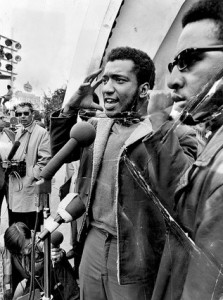 I learned of things like the FBI having files on Malcolm and every RADICAL from rap lyrics, everyday discourses of the people around me, and
  I could also see very clearly the black male students on campus, my friends, being followed by campus security and never traveling alone at night. Meanwhile, white male students would openly and defiantly do all manner of mischief with impunity. You do not need to tell me, now or before, that institutions patrol your body and your politics. So how have so many young people of color missed this point? How and why are young people from racially subordinated groups so confident that they are free online (or anywhere)? Where would such young people get such a notion when we STILL do not have the privilege that can afford the opportunity to go all over town, making a fool out of ourselves (like the white male students who I have described)? I don’t mean to denigrate young people here or even suggest they aren’t informed. Anyone would have been hard-pressed to label me as conscious when I was 18 or 19 years old. In fact, I am more critical of teachers/scholars who want to act like we can teach technological/digital tools neutrally outside of interrogations of current and historical patterns of structural racism. I only mean to suggest that many in this generation of college students have witnessed Black Freedom Struggles as commodified resistance given the changes in the organization of capital, media, and knowledge. They have not always experienced a lived history and everyday discourse of institutional surveillance and its violence. Many have certainly witnessed the patrolling/policing of their public spaces (i.e., via the NYPD for Walking While Black, Driving While Black, etc).
  But not enough understand that private spaces and social networks offer exactly the same kind of thing under structured racism and oppression, not in the way that generations before them did where every other dorm-room on my campus seemed to carry the same visual reminder that we were always being watched: the infamous poster of Malcolm looking out his window with a rifle in hand.

