I’ve never been very good with closure. Classtime runs out, we can be in the middle of a discussion, folk need to go to their next class, and I’ll just blurt out, all uncouth, well, yall, it’s time to go. And that will be the end of it. No synthesis, no last words of encouragement, no group hug. I can’t synthesize when I am still processing; and I’m not Jerry Springer with a final public service announcement. After 20 years of teaching, you’d think I would have found some solutions but I have not been able to succeed at any attempt. Maybe I just don’t think serious issues are easily resolved with dialogue alone or I am resisting the simple, Western rush to solutions and conclusions to complex issues. I no longer look for closure at the end of a class. I do put a lot of thought into the first days and weeks of my classes, but I’m not good at going out with a bang on the last day.
 When I was teaching at a small college in Brooklyn, I learned the importance of the last day though. Students in an African American children’s literature class inspired me. My plan was simple: let’s eat together on the last day and share what we have done for final projects. That’s it. Nice and simple. Well, they turnt it up and out. They brought in trays, and I mean TRAYYYYS of food. Their kids came too and told us what they liked about the literature (this was a Friday evening class of 39 women and 2 men, all of whom were thirty years old and above.) And my favorite part, of course, was the special corner, far away from the kids, that was for grown-ups only: a maxi-bar that featured a bottle of rum from what seemed like every country in the Caribbean. I made many trips to that special corner. That’s a class that I remember fondly, I can still see each face in my mind’s eyes. It’s the same for the students who did the assembly/performance with their families attending or the students with their curriculum showcases when I was a teacher educator. You can’t really predict this though. Sometimes students are as dull and dry as wheat thins; other times, they are PURE FIRE. My point is that the last class should do something, you should feel the weight of the time that you spent together, you should feel like you have been somewhere together. I no longer assume I can achieve that; students have to do that for and with one another.
 Today, however, I thought I would be compelling and close the semester with my favorite thank you speech. I would use black women’s audacity when even saying thank you to thank my class, as if it were me talking to them. I am talking about En Vogue. Instead of walking up to the stage at the 1990 Billboard Awards, all fake-surprised and theatrically-shocked that they won for their single, “Hold On,” these sistas knew they had this award and so they performed an acceptance speech that blew away the crowd– in the very style of the song that was being awarded. I don’t mean to suggest that I deserve the award En Vogue received, but I do feel like the semester was my own sort of award. I must admit that I was little impressed with myself. I had finally found a good-bye lesson plan… but then my little stuff got showed up real fast.
 Today, anthologies were due. Anthologies are, well, just that. Students create mini-curricula for their colleagues using black women’s primary texts that exemplify some rhetorical practice or process. Instead of writing the traditional Western essay for this, they create an artifact that does the analysis. Last year, Fedaling made photocopies of texts written by black women, dipped them in tea, burned the edges, and then put them all in a well-worn, beat up piece of luggage. This luggage was supposed to represent the way the family kept its identity papers, papers that had been passed down to her from generations of black grandmothers about their history and lives. An opening letter explained the significance of each text and asked the viewer to add their own writing. Aysha used the same technique and put all of these papers in a decorated shoebox, to look like something she found under her mother’s bed. Celeste created a graphic novel of black supersheroes, “TEAM ABLE” [who consist of (A) Angela Davis, (B) Bessie Smith, (L) Lucy Wilmot Smith, and (E) Ella Baker]. These women do not fight traditional, individual villains. Instead, they fight silence, inaction, and unconsciousness! You get the picture here. I am what we call a visual learner so I have always leaned on multi-media projects in class. Sometimes you just have to mix up the writing assignments because that gets boring real fast for me. Plus, I can deduce my students’ understanding of black women’s history, black women’s rhetoric, and the connections they are making just as easily, if not more easily, with such 3D/multimedia artifacts as with any written exam or essay. This year was a first though— it was a project I had never seen.
 Today, Caroline gave us a process. First, there was a collection of black women’s poems where black women discuss sexuality, their bodies; their right to love, live, and own themselves (the first image on this page). It is called “For Colored Girls!” There was an accompanying poster, now gifted to me, soon to be framed in my office (the second image on this page). The process continued with a red velvet cake with chocolate on the outside (the third image on this page). The cake was in the shape of a black woman’s torso, fully naked, demonized dark nipples in full tow, wrapped in chains (signifying too on the Swedish cake performance). Caroline cut the chains from the cake in front of all of us so that we could break this black woman free. She then offered us the inside and outside of this new black woman, ourselves.
It was the perfect closure with a group of students I will not likely forget! Like I said, the students themselves will do the work. I’m glad that I was able to listen to that first group of 39 women and 2 men who taught me this lesson many years ago.
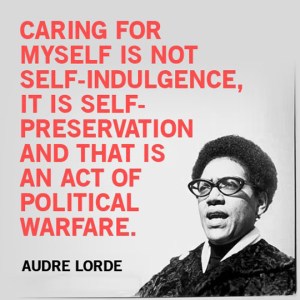
 While attending a professional event, I ran into a male colleague who lives across the country. When the day’s events ended and we went for tea, the very first conversation he initiated was a discussion about the breasts of his ex-girlfriend who was also at the event, a woman who he described as “always thick up top” (with an accompanying hand gesture to match). While also describing how she looked in the black jeans he fondly remembered her always wearing, I let the brotha slide and assumed he was delirious from trauma (this ex has dogged him in a way that I have never seen ANY woman do before…and he lets her). I will say here that this woman is an ethnic white woman (i.e., a non-Western-European woman who passes for white but does not receive full benefits as white, though her children do), a fact that will soon be relevant to this story. I don’t particularly care about black men’s racial dating preferences— I am with Mo’Nique on this one: just don’t come running back to sistas when you get disrespected and “nigger-fied,” stop expecting black women to mammy you up when you get wounded. Not even 20 minutes after his aloud remembering/daydreaming of his ex’s body, a man of color, who we both knew, joined us and then immediately complimented my appearance. My friend made sure to let me know that he was infuriated by this man’s show of misogyny in complimenting me. It is just too obvious so I won’t even bother to interpret this inclination to be offended when a sista gets a comparably respectful compliment after you have waxed on, just 10 minutes before, about a white woman’s body. Two weeks after this incident, I let the brotha know that his overly-sexualized language was not cool. Well, let me tell you, he wasn’t tryna hear NONE of that. I was just going off, my critique was coming from nowhere, my observation was inaccurate and decontextualized (he didn’t remember talking about other women’s bodies was his response, so I must have been lying), and, on top of all that, I was told I was treating him as an inferior, basically enacting white supremacy on him. Yes, I was THE ONE chasing whiteness. I was the one he said was acting like a white man. And despite being publicly D-I-S-S-E-D by this woman, he continually needed to let me know that he had deeply loved her, that she was who he had once intended to spend the rest of his life with, all a way of letting me know that he could sexualize/discuss/honor/protect his woman in any way that he wanted, whenever he wanted, and that I was too much of the inferior-black-woman-stock to dare criticize her or him. It was as if the likes of me had committed some kind of serious affront by even mentioning this woman (he was the one who always brought her up—she is simply NOT the kinda person I know). He even aggressively defended her Virtue, Truth, and Honesty by emphatically insisting that each time she initiated contact with him via social media and the like (over the course of many, many years), she always backed off if he had a girlfriend. Let me shed some light here: on each and every occasion that she initiated digitized sexual banter, her husband and small child were down the hall or maybe even in the same room (with brothaman convinced that he was simultaneously offering deep, serious commitment to the girlfriend he had nearby though he kept a skank always waiting in the wings). He was so mesmerized when this white woman claimed she loved him more than her own white husband that he could not imagine, not even for a minute, that she might be less than virtuous. Let me shed some more light here about race and gender. I know NO 40+ year old sista-professor who has unprotected sex with so many different men, WHILE still married to her white husband, that when she gets pregnant, she has no idea who the babydaddy is, confidently extorts many men for false paternity without hesitation or remorse (deliberately doctoring documents), introduces her son to all her suitors/tricks (with the boy even asking “are you gonna be my new daddy?”), and then has a black male professor adamantly defending/ praising her as the Virgin Mary Mother. These are not new behaviors that a woman would acquire at age 40 but a lifelong, devoted lifestyle. You see, sistas in the academy, or ANYWHERE, do not receive praise, love, and protection for these kinds of lifestyle choices— to paraphrase Sherri Shephard: we get called Supahead for way less than that. Less than 2 months after their “formal relationship,” the prized trophy, of course, dropped the brotha, moved on to yet another (probably, a new white man), got herself a divorce a few months later (a given when you are visibly pregnant by someone else), with brothaman so deeply wrapped in his narcissistic delusion that he saw NONE of this ish coming and couldn’t seem to grasp how and why he lost my friendship (amongst other things). NOTE: parents might want to think deeper about the kind of college classes they are paying for…ain’t no way a “professor” got time for all these EXTRA extra-marital activities and be focused on their own or somebody’s else child too. What I am most interested in here is highlighting this brotha’s automatic inclination to silence me, to let me know that I was crazy and too unworthy/non-woman/de-sexual to critique him or discuss his trophy/ethnic white woman. It is a deep memory that will always stay with me because the event we were attending was lily-white and so here I was with the only real color in the place, just as silenced and degraded as anywhere else. Though armed with an ability to memorize an arsenal of Audre Lorde quotes, it has never occurred to this brotha that his language and actions are wholly problematic, that he is wholly colonized. When you choose, over and over again, and so deeply cherish (and spend all your money on) a white woman who has never treated you as anything other than her big, dumb black buck— while calling/regarding black women as angry and bitter— you can be sure that your consciousness and spirit will never rest near the area code or time zone of Audre Lorde’s.
 This example is both extreme and mundane: extreme, in the sense that, no, most brothas ain’t this lost and pathological (I also suspect mental and/or neurological instability in this case); but the example is also mundane in that this example captures the everyday, automated kind of silence and invisibility of black women. This silence is what I believe registers my students’ deep connections to
  I can’t even begin to convey how many young women of color in my classes reiterate, time and time again when commenting to Lorde, that they have choked their words after feeling punished with labels and messages (both overt and subtle) of being loud, angry, ugly, anti-woman, unworthy, aggressive, crazy, irrational, stupid. What comes next is this: 1) a recognition that these labels and messages are silencing tactics; 2) an unwillingness to continue accepting those labels and messages as accurate; and 3) a newfound respect for shouting from the rooftops whether it be themselves or other women. I am looking forward to the final projects and final exams that I am collecting this week because I know that what I will be holding in my hands are 30 attempts at transforming silence to language and action. I know that I will hold in my hands words from wounded souls who are doing more than merely memorizing Lorde’s words but making them real, people who will actually SAY AND DO SOMETHING.


