About Carmen Kynard

Carmen Kynard is Lillian Radford Chair in Rhetoric and Composition at Texas Christian University. Her award-wining research, teaching, and scholarship interrogate anti-colonialism, Black feminist pedagogies, and Black cultures/languages.

Post-Surveillance, Literacies, and Digital Empire

A colleague told me about a student who missed class due to a claimed family illness or something like that.  While the student was, supposedly, sick and out of town, he was, in fact, in town and tweeting about being drunk and the fun he was having.  A student who I never met, but heard a lot about, once posted crazy rantings about the violence he would inflict on campus on Facebook, as a joke, only to find campus security at his door the next day.  Now, in general, I tend to see such young people as hopelessly clueless and want, desperately, to ask them: have you lost your d#%& mind?   But I also know of a graduate student who got fired from a student services job because she posted compromising photos of herself and her co-workers on facebook.  That wasn’t an 18-year old, who we can somewhat dismiss for youthful foolishness; that was a graduate student somewhere in her late twenties.  I could tell countless stories like this and have heard countless other stories from other folk.  There is a kind of general discourse that this generation simply does not erect barriers to their private and public identities the way someone in my generation might— a post-civil rights baby, born in the early 70s, who grew up in the 80s.  But the issues of private-vs-public as a generational marker and difference between myself and the foolishness I have described is too simple.  I think there is more going on here and I think it has to do with my generation and those before me understanding, living in, or living immediately after what was a pretty explicit, surveillance culture.  Clearly, young people’s digital presence is surveilled given how easily and quickly all of these folks got caught doing this mess.  However, few seem to expect that surveillance will exist.

Image.ashxI get why privileged/elite/white youth might not think they are being surveilled.  If you have been taught (even if only implicitly so) that you are at the center of the world and given a material reality to support that view, then why would you feel like you are not in complete control?  But for racially, subordinated groups, what accounts for this lack of insight?  This is where the embodied and inherited awareness of an explicit surveillance culture becomes a generational marker for me.  When I was in college in 1991, Clay Carson, as just one example, had just published Malcolm X: The FBI File. At that time, there simply had not been a great deal of “serious” biographical and historical research on Malcolm, to quote from Carson.   In 1978, when I was seven years old, the Freedom of Information Act (FOIA) made documents like Malcolm’s FBI file (file 100-399321) accessible, available even at many university research libraries.  In 1987, the FBI also released the New York office file on Malcolm (file 105-8999) based on 1964 surveillance of Malcolm’s home phone.   The point is: when Carson’s book was released, the energy on campus was palpable because the things we had really only heard rumors of in our communities were now collected in one book.  I have owned many copies of the book since undergrad, but have never been able to keep it on a shelf given the many borrowings and non-returns.  The book is as much a part of my youth as the Autobiography.
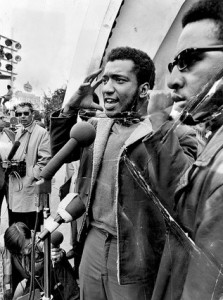
ty4f97d632I learned of things like the FBI having files on Malcolm and every RADICAL from rap lyrics, everyday discourses of the people around me, and PBS’s 1987 broadcast of Eyes on the Prize.  No one ever told me any of these things in school.  I also knew what COINTELPRO was before anyone ever mentioned it in a college classroom. I knew that this was one helluva operation given the way it manifested the brutal murder of Fred Hampton in his bed, while his pregnant girlfriend, Deborah Johnson (Akua Njeri) was right there watching.  Even wikipedia has photos of the bloody bed and of Hampton’s body being dragged out.

tumblr_lf6xfzMGFp1qc0pg7o1_1280I could also see very clearly the black male students on campus, my friends, being followed by campus security and never traveling alone at night.  Meanwhile, white male students would openly and defiantly do all manner of mischief with impunity.  You do not need to tell me, now or before, that institutions patrol your body and your politics. So how have so many young people of color missed this point?  How and why are young people from racially subordinated groups so confident that they are free online (or anywhere)?  Where would such young people get such a notion when we STILL do not have the privilege that can afford the opportunity to go all over town, making a fool out of ourselves (like the white male students who I have described)?  I don’t mean to denigrate young people here or even suggest they aren’t informed.  Anyone would have been hard-pressed to label me as conscious when I was 18 or 19 years old.  In fact, I am more critical of teachers/scholars who want to act like we can teach technological/digital tools neutrally outside of interrogations of current and historical patterns of structural racism.  I only mean to suggest that many in this generation of college students have witnessed Black Freedom Struggles as commodified resistance given the changes in the organization of capital, media, and knowledge.  They have not always experienced a lived history and everyday discourse of institutional surveillance and its violence.  Many have certainly witnessed the patrolling/policing of their public spaces (i.e., via the NYPD for Walking While Black, Driving While Black, etc).  malcolm-x-with-rifle-e1332775977757But not enough understand that private spaces and social networks offer exactly the same kind of thing under structured racism and oppression, not in the way that generations before them did where every other dorm-room on my campus seemed to carry the same visual reminder that we were always being watched: the infamous poster of Malcolm looking out his window with a rifle in hand.

More importantly, I think that it is lethally dangerous for young people of color to imagine that they will be free in a digital empire.  They can fight for and take their freedom (or, as Malcolm might say: swing up on some freedom), as Black people always have, but it will not be freely given. This will mean, in part, taking back the discourse on and dissemination of knowledge about Black Freedom Struggles so that it can be a practice… a literacy skills-set… and an ideology… rather than merely another object of academic analysis or a rhyming gimmick/jingle for McDonald’s or BET.  Fighting for freedom in digital empire can, in the least, start there.

White Flight, Unspeakable Violence, and Continued Grieving (Sandy Hook School Shootings)

Like most people right now, I have had a knot in my stomach since last Friday when Adam Lanza, a 20-year old white male, shot and killed twenty small children at Sandy Hook Elementary school in Newtown, Connecticut along with the six adults who tried to shield them.  It seems that some of those children had as many as 11 bullets ripped into their tiny bodies.  National grief, horror, and mourning are deeply palpable.  If I feel like the wind gets knocked out of me every time I hear about the murder of these children and witness more funeral preparations, then the grief of the families and this nearby town must be unspeakable.

Screen Shot 2012-12-17 at 1.10.36 PMWhat is also palpable for me right now is the mainstream void of social analysis of the violence that our social organization inflicts.  Maybe, it is too soon.  Or maybe, we are still unable to really look at who we are and what we have created and so hide behind bourgeois sentimentalism.  E.M. Monroe’s blog posting at “Miles Away” came at just the right time for me.  Monroe reminds us of the history of violence against children with a photo of Sarah Collins, the one survivor who was in the bathroom when the bomb exploded and killed “4 Little Girls” at the 16th Street Baptist Church on Sunday, September 15, 1963 as the children were preparing for “Youth Day” services.  Schools were not closed afterwards and every black child of the era was forced to emotionally and psychologically move on as if nothing had happened to their peers.  Monroe tells us— even reminding us about Christopher Paul Curtis’s wonderful children’s novel, The Watsons Go to Birmingham, 1963  that we have cultural and historical precedents that can guide us for how we must both heal and confront the world which we have created.  With the incessant cries that The Root recently chronicled of white people mourning their loss of power and voice in a social climate where a black man can now be president TWICE, the violence that we have now witnessed will only continue and compliment the violence that we have always allowed.

I can’t help but think about my own days teaching in New York City.  When I began teaching in 1993, bars on windows and full body metal detectors were quite normative.  When I taught junior high school in the Bronx, 11 and 12 year old children, I was required to always keep my classroom door shut and locked from the inside so that no one could enter without a master key.  Strangely, this was not done for the protection and safety of those children, young (and tiny) as they were; this was done based on a criminalization of those children, based on the violent marking of their very being as subhuman.  1980s and 1990s white flight into Newtown (and many other, new towns neighboring it), with entities like the FHA over-investing in their livelihood (while divesting in the brown and black city spaces where I taught), actually helped create the very conditions that I describe during my teaching.  These conditions merely replicated histories of places like Harlem in the 1920s, then the Black Mecca. When Black migrants from the Caribbean and Southern United States settled into New York City/Harlem, whites lobbied the politicians, bankers, and real estate agents to restrict them to designated black neighborhoods and schools only.  The cycle only continues given the huge losses brown and black peoples faced at the housing market crash and recession. If we see these kinds of divestments in people’s minds, bodies, and safety, then we can better understand exactly the kind of social violence we live in.  Violence has always been around us; Newtown was never exempt, safe, or innocent. And children and schools have always been caught right in the middle.  As “Sweet Honey in the Rock” proclaim here, it doesn’t matter where you’re living:

As simple as it may sound, we have never valued children’s lives.  Valuing only white children and not black and brown children IS violence.   Until we can realize this and act toward a new system, we can’t expect a social environment that will manifest real justice and protection for any children.

“The Cypher is Forever” (Fall Semester Ends…)

Da_Brat-stunning_thumb_585x795This fall semester is now officially over: the last individual meetings are happening now; the final projects are due today; and Jack just stopped by with his Finals-Week-Full-Beard in Full Effect!   (You know the semester is over when your students talk about going back home to sleep and shave.)

Like I have said before in this forum, this is my first time teaching the class, African American Literacies and Education.  Together, with the use of Jigsaw Reading assignments and literature circles (see course introduction and syllabus), we have discussed more than a 100 texts related to histories and polemics of race, black cultures, people of African descent, and literacy.  When I walk out into the library, I see laptops and stacks of those texts everywhere and students so focused, they don’t notice me walk past.  Yes, the end is here!

For lack of a better way to say it, the students in this class were always “good sports.” Whatever pedagogical concoction I had going for the week, they smiled and tried it out.  My favorite experiment of the semester was the chart-making we did during the week that we read and discussed Adam Banks’s book, Digital Griots.  Writing on the walls via charts and colorful markers tends to always make its way somehow into my classrooms.  On this day, I wanted us to really unpack what Banks was defining and theorizing as the intersection of digital/griotic traditions, African American rhetoric, and multimedia composing in the 21st century.   Equally important, I wanted an initial, full and equal discussion representing every single person/voice in the room.   Instead of having oral conversations, we had visual/charted conversations to jumpstart the discussions of the evening.  What I liked most was the verbal creativity students spit on the walls and the shower of words, images, and symbols we had created in relation to and with African American rhetoric, right there in the classroom.

In three different areas of the classrooms, I taped (very large) charts to the walls.  Each corner had a different discursive function, a different sentence for each student in the class to finish on the chart itself, and each student was expected to rotate the room and add their sentence “tag” somewhere in each corner.  Now my students might find me overly sentimental here when I say their writing/tags were HOTTT, so maybe their verbal gangsterism can speak for itself.  The bullets below are a sampling of how it went down collectively with my sentence starters (in yellow) and their collective finish-closers (in bulleted italics):

The African American Deejay is central as a cultural figure/icon and metaphor because…

  • s/he is a constructivist, archivist, and figure who provides access to people who were never supposed to receive the message in the first place!
  • s/he blends cuts for listening and feeling to give us history, technology, purpose, commitment AND tools of persuasion.
  • she molds space, takes it, interprets it and brings all that into the future for her people.
  • she re-sparks the interest in and for her people.
  • s(he) brings a different lifestyle to the world, representing those that live it, keeping it current and liquid, while bonding it to its people.
  • the digital griot moves past just deejaying and makes it a form of pedagogy that links Black language to the people as a new technology.
  • they make the co-existence of “the contradictory, overlapping, open, closed, and fluctuating systems of exchange” into art.
  • she creates direction and guidance for new thinking and social unity.
  • they rock the party and set the mood.
  • they are a living symbol of what African American literacies do.
  • they reactivate black participation.
  • it’s in the mix that the story gets told… and the sequence determines how the crowd moves to it.
  • he/she studies the people’s passions, reconfigures their perspectives and their experiences and motivates them to mobilize/move.

Putting this concept of a digital griot, into words, basically taking a book and reducing it into a sentence or a 1-hour discussion was not so easy so I was hoping this collective showers of words pasted to the walls in the room would add the necessary dimensionality.  Here is how that looked (my sentence starter is in yellow and students’ collective finish-closers are in bulleted italics).

Digital Griots are…

  • the spaces and spacemakers that have a humanistic, individualistic, communal approach to knowledge, knowing, and writing.
  • activists with a digital groove.
  • the manipulators of technology where the keeping of history is maintained for positive sociocultural recognition, change, and advancement.
  • ethically responsible, constantly searching, provocative seers.
  • modern-day perpetuators of oral tradition, storytelling, and time-binding.
  • interactive archivists.
  • my uninhibited space-makers who let us exist without judgment in real and protected ways.
  • liberatory Lil’ Jon.
  • the new school transmitters of new Black narratives.
  • the modern-day storytellers who bring “back in the day” into the right now.

And of course, there was my favorite corner: the re-mix of the SAT analogy! Yes, we can re-mix that too!  (My sentence starter is in yellow and students’ collective finish-closers are in bulleted italics).

The African American Deejay/Digital Griot is to the multimedia age what _________ is to ___________:

  • collard greens are to cornbread: always integrated and soul/body-sustaining.
  • parents are to children: conception and birth.
  • grandparents are to parents are to children: past, present, AND future.
  • head chef/big mama is to the kitchen.
  • red bottoms are to stilettos.
  • new kicks are to my favorite dress.
  • Jazz is to America.
  • voice is to words.
  • the pastor is to the church community.
  • Marvin Gaye is to Taleb Kweli.
  • Nikki Giovanni is to Jill Scott.
  • line break is to poetry.

In many ways, this was the kind of intellectual and political energy that students were pushing themselves to write and think into all semester as I read their response papers each week.   This sampling of my students’ writings on the classroom walls encapsulates the semester quite well for me.

I am thinking now about conversations that I had with two students, Cassandra and Ancy, in my office this week, namely that African American Literacies, Black Language, right living, just schooling, and racial equality are not just the subject of study: it’s how we must remember; it’s how we must remember to live and act and fight.

I opened the semester talking in my syllabus how I once missed the mark (i.e., my artwork/essay showcasing da Brat) with my high school students to fully examine and center African American Literacies as a practice and lived theory.  As to whether or not I hit it right this time, well, I will need more time and space to reflect on THAT.  All I know right now is this semester’s focus on African American literacies and education came with an important message about what that work means: Lateef’s reminder in class a few weeks back that… the cypher is forever.

So to: Ancy, Cassandra, Dan, Dani, Daniel, Fedaling, Jack, Jeanette, Jenn, Lateef, Laura, Nancy, Nick, Princess, Regina, Rory, Sammantha, Stephanie, and Torrie… much love and gratitude to you all for sharing a classroom space with me this semester!

Race, Publishing & Rhetoric of Rejection

Tonight is the last class of the semester where students will be talking about their final projects, work we have been moving towards all semester in the writing projects.  Every aspect of this course— the syllabus and the weekly topics— have been pretty much made visible on this website.  And with wordpress, I can see what search terms people are using to land on the website. It takes a while for google to really “see” and list a new website so the first months and weeks of this class/website leave no real footprint to track. But, in these last two months, that has started to change.  And guess what course topic has coincided with what people search for most often?  The picture of Eric B. and Rakim at the right posted under “I Know You Got Soul”!  Thass right!  It seems appropriate that we make a note of this fact in a class on African American Literacies and Education!

I designed and proposed this course to my college more than a year ago now and this group of students are the first to experience it!  To wrap up, I am asking students to enter the fray now as researchers, with their own publication-ready pieces.  These final research projects will be graded and responded to as if they were journal articles. The options are a) a 30-page article in a research journal (print or online); b) a 15-page article in a research journal (print or online) (I ask that students not make the mistake of thinking that just because the articles in these journals are shorter, that they are somehow easier to write or that the expectations for citations, etc are somehow less stringent.  It just means that you say more in less space!); OR c) a multimodal webtext  (the target journal is Kairos and the webtext that was awarded the best webtext of the year).  Students have been working on these topics through the semester and now need to meet the following requirements:

1)    Offer a definition of and brief historical connection to African American literacies

2)    Reference and/or show how they are using Elaine Richardson’s work

3)    Have, at minimum, 30 citations in works cited AND in-text citations

4)    Use MLA or whatever style the target journal wants

5)    Show an original, theoretical position or qualitative/quantitative project

6)   Communicate methods clearly (if using human subjects, the IRB protocol number and all consent forms must be submitted)

But what I want to actually talk about tonight is getting students to really submit their works to a journal.  This means that students will have to go out on a limb and do what graduate students seldom do: let go of fear and insecurity… in other words: allow themselves to risk getting their work rejected.  There is a certain kind of exposure, a raw nakedness, with submitting work for publication when you do not have an “in” with that journal.  But if the work really moves past the bourgeois recitation of the right formulas and popular trends/tropes in the field, then exposing that work and set of ideas is exactly what we need to do.

I have been asked on numerous occasions, how I get articles published. The answer is really simple.  I don’t fret the rejections!  I just find another intellectual home for my work and, let me just say, I have heard ALL manner of foolishness.  When I have used expressions of my family, especially my grandmother from rural Alabama, I have been told that she is too ignorant to reference in academic work (these people only get away with such comments because they are protected by blind review— if I knew who they were, I can promise you that they would never say such a thing to or about a black woman ever again).  I have been OFTEN told that people are not interested in black women’s writing— “why is it even relevant” was the exact question I once received.  I have been frequently told that my work is appropriate for cultural studies, but not for writing studies.  I have been told that I need to explain why I have street literacy.  I have been told that audiences outside of the U.S. will not recognize Black culture/ Black English in my work (as an aside: the searches for Eric B. and Rakim are only written in ENGLISH 50% of the time!)  I have been told that my writing style needs to be more gentle.  These are pretty much exact quotes and not even the 1/2!  I was even told once that I do not know how to write at all (go back and check my earlier statement about blind review). With such rejections, all from comp-rhet sources, I receive a new and worthwhile, intellectual exercise: I get to confront an unyielding whiteness and nepotism in a space where not enough really criticize that.  I am grateful for all of these comments: I get to hear people’s true politics, see who they really are, and I get to find myself a better community to connect with.

So I simply keeps it movin now.  I want my students to know and do the same: if their piece is rejected at first and they really believe the work moves past the banal celebrity culture of academia and its trendy catch-phrases and, instead, confronts racism in the experiences of black folk to stall racism (rather than profit from it), they need to know now not to trip on these rhetorics of rejection and keep it movin intellectually too.  You can’t expect a world which dehumanizes black people to create an academy with a set of most white faculty and bourgeois minority allies that can then turn around and respect black folk.  And you can’t give up because white racism rejects you— it is just acting within the terms of its own logic.

So, maybe the folks landing on this website know something important: we should just take it back to Eric B. and Rakim and “hold the microphone like a grudge”… there IS a world out there willing to hear that: