
I’m not someone who tweets so maybe I just don’t get it. Maybe. When I see what happens there (and yes, I do call twitter a social place/location), I am sometimes stunned. But then again, these are the kinds of discourses that have always happened behind closed doors anyway.

Ad from Oregon PBS about History of Sex Education Classes
Let’s take, for instance, a woman who has semi-regularly tweeted photos of public sexual innuendos like signposts with the word, HUMP, on them. It’s almost sophomoric, like in junior high sex education classes when the teacher shows photos of male and female genitalia and everyone starts laughing. Except this ain’t a kid, this is a grown, professional woman who marks herself as a feminist. Certainly, feminist consciousness demands that women’s bodies not be circumscribed and defined by Puritan notions of sex and sexuality and instead empowers women’s bodies from alternative spaces of consciousness and politics. I get that. Really, I do. But this ain’t that so let me cut to the chase: I just can’t see myself, as a black female professor, lasting too long if I tweet out sophomoric sexual discourses for fun, with photos, and so willingly offer up a sexualization of my body in public spaces as a hobby for my pastime. I can tell you that it wouldn’t go well for me professionally and black male professors certainly wouldn’t be out here calling me their sister-in-arms as the second coming of the Angela Davis/Black Power Mixtape. It just doesn’t go down like that. Not for black women. For those of us who consider ourselves real students of black women’s histories and black feminisms, we know that we live under very different scripts for race and gender. This twitter example that I am describing is not hypothetical; it represents the very real activities of a non-black female “professor” (in quotation marks since the person engages no intellectual/scholarly pursuits). Now what on earth would ever embolden a professional/professor to initiate such public, sexual invitations and expect relative impunity with no negative result? That answer comes quite easily for me: the sense of freedom that comes with white entitlement… and, well, all of us ain’t entitled that way; all of us ain’t free.
Some might view my perspectives as conspiratorial or over-the-top but if you are a black woman, you better wake up fast because you don’t have the luxury of such dismissals. You’ll see exactly what I am talking about when you witness white co-workers criticize black applicants for their lack of a far-reaching scholarly identity in their digital footprint though these white folk themselves ain’t got nothing nowhere about themselves and their scholarship. You’ll see exactly what I am talking about when you witness white co-workers scrutinize a black woman’s resume, comparing it to items that can be googled— this for a black woman who has dozens upon dozens of lectures and accolades online, too many to count. Meanwhile, the ridiculous onslaught of online tributes to vampires created by the non-black-female applicant goes unmentioned and unnoticed. You just can’t make this stuff up. Like I said, if you are a black woman, you would be stupid to think you can ignore this because non-black folk dismiss you as paranoid… while, of course, they never hire anyone who looks like you. Don’t you be THAT kind of fool.

Eunique Jones’s “I am Trayvon Martin” Photo Campaign
About ten years ago, I taught an intensive summer, 3-hour college writing course in the evenings and we had class on July 3. All of my students in that course were of African descent; most expected me to cancel class since the 4th was the next day. They kept asking over and over: but what will we do in class on that day? to which I answered: the same damn thing our ancestors had to do— WORK and FIGHT BACK! You ain’t free. Now, some of my students thought that was hilarious and appropriate; others were mad as hell at me and either way, I didn’t give a damn. We had class and we spent the time reading and discussing “What to the Slave is the Fourth of July” by Frederick Douglass alongside current events of the moment. If I were teaching that same class today, I would do the same thing. And I would add to that assignment the footage from the current trial proceedings related to George Zimmerman’s vicious murder of Trayvon Martin. And I would add to that William Lamar IV’s piece at the Huffington Post on why he will reflect on the 4th of July, but not celebrate.
I am reminded every day of the ways that I am not free, even in the seemingly mundane ways that other women not-of-Afrikan-descent are so casually emboldened to do things that I could just never get away with and maintain a positive social reputation, job, and respect. I don’t mean to be the grim reaper for my students and disempower them with stories of racism. But empowerment comes from seeing the world as it is so that you can intervene in it, not from creating fantasies, delusions, and false belief systems. The good thing about all that is there is a tradition for the 4th of July, going all the way back to Frederick Douglass’s 1852 speech, leading the way.

 As soon as that “meeting” started, I noticed the peculiar way the chair and her
  These women of color on my first campus as a tenure track professor were phenomenal and though I knew they were dope when I was there, I never fully realized that having a set of sistafriends on your campus to lift your head is a sho-nuff RARITY! Notice that I said: women of color who are sistafriends. That is NOT the same as having women of color on campus. I am not talking about the kinds of women of color who come talk to you in closed offices but never speak up in public settings, a strategy often learned early on because it is so handsomely rewarded in graduate school. These women might say they keep quiet because no one is listening to them but, more often, they choke their words to not lose favor with those in power, not ruffle white feathers, not take any risks, or not lose their token status (and many times go home to wealthy, breadwinning, and/or white husbands). They are, in sum, passing for white. I ain’t talking about THEM women of color. I am talking about the sistas who read their environments openly and will read the institution out loud with you and, especially, when the time is right. Quite honestly, I assumed that I would find a sistacypher like this everywhere, that institutional racism would inevitably mean as much, but I have learned otherwise. What I have missed most about these sistafriends is the way they read institutional racism AND patriarchy. You see, that’s that rare gem right there. Talking up institutional racism does not always come with talking up patriarchy and misogynoir and I mean something more than talking about public spectacles from the likes of fools like Rick Ross. I mean talking about the day-to-day workings of men in our workplaces— white men and men of color— all of their immediate articulations of societal structures, social hierarchies, and violence: we didn’t just co-sign our misogynistic black men colleagues who were actin the fool (dropping their “seed” anywhere, taking women students out for drinks, text-messaging/calling/visiting/closing-the-door with women students, etc); nor did we leave our feminism at the door and blindly support the campus’s white patriarchs and their violence. Like I said, I have learned the value and rarity of these kinds of sistas in these past years. You see, these were women who read men AND nations.
 This semester, I wanted to really think about the reverberating references to black women that have occurred across multiple semesters of my teaching. Part of me is responding to a tendency of mostly white teachers to describe mostly white students who reference a litany of white authors and novels in the course of classroom discussions. This gets marked as intelligent and well-read . However, within the scope of these parameters, I have never heard any black student be referenced in the same way for knowledge of black cultural history and persons (and what passes as KNOWLEDGE of people of African descent, even at the graduate level, is often so dismal that I am utterly embarrassed for all parties involved). At best, when undergraduate students of African descent reference black cultural histories, these are treated as personal connections, not literate connections (as if white students describing white authors is NOT also about personal connection). Alternatively, black students might be seen as activating their prior knowledge which is admirable and tolerated but that is not the same as regarding these moments as sophisticated analyses.
  While attending a professional event, I ran into a male colleague who lives across the country. When the day’s events ended and we went for tea, the very first conversation he initiated was a discussion about the breasts of his ex-girlfriend who was also at the event, a woman who he described as “always thick up top” (with an accompanying hand gesture to match). While also describing how she looked in the black jeans he fondly remembered her always wearing, I let the brotha slide and assumed he was delirious from trauma (this ex has dogged him in a way that I have never seen ANY woman do before…and he lets her). I will say here that this woman is an ethnic white woman (i.e., a non-Western-European woman who passes for white but does not receive full benefits as white, though her children do), a fact that will soon be relevant to this story. I don’t particularly care about black men’s racial dating preferences— I am with Mo’Nique on this one: just don’t come running back to sistas when you get disrespected and “nigger-fied,” stop expecting black women to mammy you up when you get wounded. Not even 20 minutes after his aloud remembering/daydreaming of his ex’s body, a man of color, who we both knew, joined us and then immediately complimented my appearance. My friend made sure to let me know that he was infuriated by this man’s show of misogyny in complimenting me. It is just too obvious so I won’t even bother to interpret this inclination to be offended when a sista gets a comparably respectful compliment after you have waxed on, just 10 minutes before, about a white woman’s body. Two weeks after this incident, I let the brotha know that his overly-sexualized language was not cool. Well, let me tell you, he wasn’t tryna hear NONE of that. I was just going off, my critique was coming from nowhere, my observation was inaccurate and decontextualized (he didn’t remember talking about other women’s bodies was his response, so I must have been lying), and, on top of all that, I was told I was treating him as an inferior, basically enacting white supremacy on him. Yes, I was THE ONE chasing whiteness. I was the one he said was acting like a white man. And despite being publicly D-I-S-S-E-D by this woman, he continually needed to let me know that he had deeply loved her, that she was who he had once intended to spend the rest of his life with, all a way of letting me know that he could sexualize/discuss/honor/protect his woman in any way that he wanted, whenever he wanted, and that I was too much of the inferior-black-woman-stock to dare criticize her or him. It was as if the likes of me had committed some kind of serious affront by even mentioning this woman (he was the one who always brought her up—she is simply NOT the kinda person I know). He even aggressively defended her Virtue, Truth, and Honesty by emphatically insisting that each time she initiated contact with him via social media and the like (over the course of many, many years), she always backed off if he had a girlfriend. Let me shed some light here: on each and every occasion that she initiated digitized sexual banter, her husband and small child were down the hall or maybe even in the same room (with brothaman convinced that he was simultaneously offering deep, serious commitment to the girlfriend he had nearby though he kept a skank always waiting in the wings). He was so mesmerized when this white woman claimed she loved him more than her own white husband that he could not imagine, not even for a minute, that she might be less than virtuous. Let me shed some more light here about race and gender. I know NO 40+ year old sista-professor who has unprotected sex with so many different men, WHILE still married to her white husband, that when she gets pregnant, she has no idea who the babydaddy is, confidently extorts many men for false paternity without hesitation or remorse (deliberately doctoring documents), introduces her son to all her suitors/tricks (with the boy even asking “are you gonna be my new daddy?”), and then has a black male professor adamantly defending/ praising her as the Virgin Mary Mother. These are not new behaviors that a woman would acquire at age 40 but a lifelong, devoted lifestyle. You see, sistas in the academy, or ANYWHERE, do not receive praise, love, and protection for these kinds of lifestyle choices— to paraphrase Sherri Shephard: we get called Supahead for way less than that. Less than 2 months after their “formal relationship,” the prized trophy, of course, dropped the brotha, moved on to yet another (probably, a new white man), got herself a divorce a few months later (a given when you are visibly pregnant by someone else), with brothaman so deeply wrapped in his narcissistic delusion that he saw NONE of this ish coming and couldn’t seem to grasp how and why he lost my friendship (amongst other things). NOTE: parents might want to think deeper about the kind of college classes they are paying for…ain’t no way a “professor” got time for all these EXTRA extra-marital activities and be focused on their own or somebody’s else child too. What I am most interested in here is highlighting this brotha’s automatic inclination to silence me, to let me know that I was crazy and too unworthy/non-woman/de-sexual to critique him or discuss his trophy/ethnic white woman. It is a deep memory that will always stay with me because the event we were attending was lily-white and so here I was with the only real color in the place, just as silenced and degraded as anywhere else. Though armed with an ability to memorize an arsenal of Audre Lorde quotes, it has never occurred to this brotha that his language and actions are wholly problematic, that he is wholly colonized. When you choose, over and over again, and so deeply cherish (and spend all your money on) a white woman who has never treated you as anything other than her big, dumb black buck— while calling/regarding black women as angry and bitter— you can be sure that your consciousness and spirit will never rest near the area code or time zone of Audre Lorde’s.
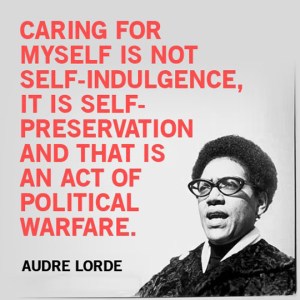 This example is both extreme and mundane: extreme, in the sense that, no, most brothas ain’t this lost and pathological (I also suspect mental and/or neurological instability in this case); but the example is also mundane in that this example captures the everyday, automated kind of silence and invisibility of black women. This silence is what I believe registers my students’ deep connections to
  I can’t even begin to convey how many young women of color in my classes reiterate, time and time again when commenting to Lorde, that they have choked their words after feeling punished with labels and messages (both overt and subtle) of being loud, angry, ugly, anti-woman, unworthy, aggressive, crazy, irrational, stupid. What comes next is this: 1) a recognition that these labels and messages are silencing tactics; 2) an unwillingness to continue accepting those labels and messages as accurate; and 3) a newfound respect for shouting from the rooftops whether it be themselves or other women. I am looking forward to the final projects and final exams that I am collecting this week because I know that what I will be holding in my hands are 30 attempts at transforming silence to language and action. I know that I will hold in my hands words from wounded souls who are doing more than merely memorizing Lorde’s words but making them real, people who will actually SAY AND DO SOMETHING.


